Artificial intelligence is changing healthcare quickly.
But something else is changing alongside it.
The way healthcare professionals learn from each other is evolving too.
Doctors are using AI to review medical research. Nurses are experimenting with tools that support documentation. Researchers are using AI to work through large amounts of information. Healthcare leaders are trying to understand which tools deserve investment and which ones create more problems than they solve.
None of these decisions happen in isolation.
Clinicians talk.
They ask colleagues what they are using. They share experiences. They question results. They warn each other when something does not work.
That is why AI and healthcare communities are growing together.
AI can provide information in seconds.
A healthcare community provides something different.
It provides context.
And healthcare needs both.
A few years ago most conversations about healthcare AI were about what might happen in the future.
That future arrived quickly.
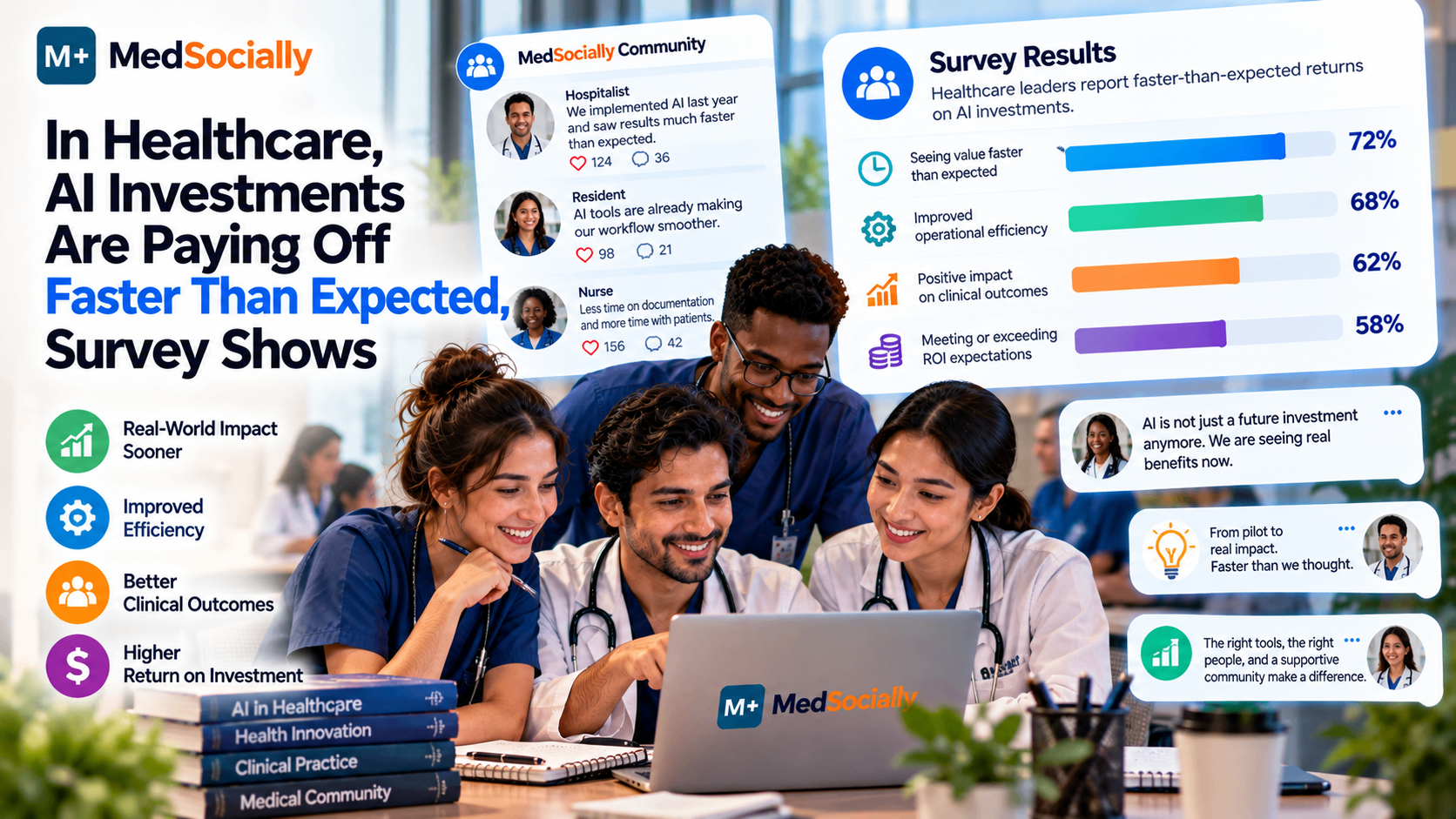
The American Medical Association reported in 2026 that 81 percent of physicians surveyed were using AI professionally. That was more than double the 38 percent reported when the AMA first surveyed physicians about AI in 2023.
The most common use was not robotic surgery or autonomous diagnosis.
It was something much more practical.
Physicians were using AI to summarize medical research and standards of care. Other common uses included creating clinical documentation and summarizing charts.
This tells us something important.
AI is becoming part of how healthcare professionals manage information.
Medicine produces enormous amounts of knowledge. New studies appear constantly. Guidelines change. New treatments emerge.
No clinician can read everything.
AI can help organize that information.
But organizing information and understanding what it means are two different things.
That is where healthcare communities become important.
Imagine a physician asks an AI tool about a new treatment.
The response looks convincing.
It includes a mechanism of action. It summarizes a few studies. It suggests which patients might benefit.
The answer may be useful.
But the physician may still want to know something else.
Has anyone actually used this treatment?
Did the results match the research?
Were there problems that the AI response did not mention?
Would another specialist interpret the evidence differently?
These are human questions.
Healthcare professionals have always relied on each other for this type of knowledge.
AI does not remove that need.
It may actually increase it.
As AI produces more information clinicians need trusted places where they can compare that information with clinical experience.
A strong healthcare community can become that second layer.
AI finds the information.
People discuss what it means.
Medicine has never advanced through textbooks alone.
Think about how physicians actually learn.
A resident asks an attending about a difficult patient.
A hospitalist calls a specialist.
A surgeon discusses an unusual complication with a colleague.
A nurse tells another nurse about a workflow problem that nobody noticed when a new system was introduced.
A physician hears about a study and asks other clinicians whether it is changing their practice.
Healthcare knowledge moves through relationships.
Digital healthcare communities take that same behavior and allow it to happen across hospitals and geographic boundaries.
A physician in a community hospital may be able to learn from someone at an academic center.
A nurse may discover that a workflow problem affecting their hospital is happening elsewhere too.
A researcher can hear how clinicians are responding to a new technology outside the research environment.
AI can make these conversations faster because it gives professionals more information to discuss.
But the community gives that information meaning.
Every new healthcare technology creates questions.
AI creates a lot of them.
Should clinicians use generative AI to summarize research?
Can an AI generated discharge instruction be trusted?
What happens when an AI system disagrees with a physician?
Who is responsible when an AI recommendation contributes to harm?
Should patients use AI before seeing their doctor?
Can clinical skills weaken if younger physicians depend too heavily on AI?
These are no longer theoretical concerns.
In the AMA's 2026 survey 88 percent of physicians reported at least some concern about potential skill loss related to healthcare AI. Eighty eight percent also viewed strong safety and effectiveness validation as important for wider adoption. Another 85 percent wanted physicians to be involved in decisions about adopting AI tools.
That last number is especially important.
Healthcare professionals do not simply want technology delivered to them.
They want a voice in how it enters healthcare.
Healthcare communities can help create that voice.
There is another challenge developing alongside AI adoption.
Not every healthcare professional understands AI in the same way.
Some clinicians are already experimenting with multiple tools.
Others are still trying to understand what a large language model actually does.
Some may trust AI too easily.
Others may distrust it completely.
Neither extreme is particularly useful.
Healthcare professionals need practical AI literacy.
They need to understand what these systems can do.
They also need to understand where they fail.
A healthcare community can make that learning more practical.
Instead of learning only from technical courses clinicians can learn from real experiences.
Someone might share how an AI documentation tool saved time but created inaccurate wording.
Another physician might explain why a clinical AI recommendation looked reasonable but missed an important part of the patient's history.
A pharmacist might point out a medication issue.
A researcher might explain why a new study should not yet change clinical practice.
Those conversations can teach something that a product demonstration cannot.
They show AI in the real world.
There is another reason AI and healthcare communities fit naturally together.
AI problems do not always appear immediately.
A tool may perform well during testing.
Then clinicians begin using it.
A physician notices an unusual recommendation.
A nurse finds that the tool adds steps to the workflow.
Another hospital sees similar behavior.
One isolated complaint may be easy to dismiss.
Dozens of healthcare professionals describing the same problem deserve attention.
Online healthcare communities can help patterns become visible.
This does not replace formal reporting or clinical governance.
It adds another source of real world information.
The same principle already exists throughout medicine.
Doctors discuss unusual adverse effects.
Researchers debate new evidence.
Professional groups challenge guidelines.
Healthcare AI should be exposed to that same level of discussion.
There is also a risk.
Healthcare communities could become filled with AI generated content that looks professional but says very little.
Articles can be generated automatically.
Comments can be written automatically.
Clinical summaries can be created in seconds.
If every conversation begins to sound like it came from the same machine then the value of the community decreases.
People join professional communities because they want access to other people.
They want experience.
They want judgment.
Sometimes they even want disagreement.
That human layer has to remain.
The best use of AI inside healthcare communities may not be to replace conversation.
It may be to make good conversations easier.
AI can help professionals find relevant research.
It can organize complex discussions.
It can summarize long information.
It may help people discover experts or topics they care about.
But the physician's experience still matters.
The nurse's perspective matters.
The patient story matters.
AI should support those voices rather than drown them out.
This is where platforms designed specifically for healthcare can become more valuable.
General social networks were not built around the needs of clinicians.
Healthcare conversations often require more context.
Professionals want to discuss research. Clinical practice. Career development. Healthcare technology. Patient safety. Policy. Medical education.
Platforms such as MedSocially can bring these conversations into a dedicated healthcare community where physicians and nurses can connect with researchers and other healthcare professionals.
The opportunity becomes even more interesting as AI adoption grows.
A healthcare professional may discover a new AI tool.
Instead of relying only on the company's website they can ask other clinicians what they think.
Someone considering a new clinical AI platform can learn from people who have already tested similar technology.
A physician reading an AI generated summary of a study can discuss that evidence with specialists who understand the topic deeply.
That is a healthier model for AI adoption.
Technology provides speed.
Community provides perspective.
The future of healthcare AI will not be decided only by engineers.
It will be shaped by the clinicians who use these systems every day.
That means physicians need spaces to talk openly about what works.
Nurses need a voice.
Researchers need ways to hear from people practicing outside academic centers.
Healthcare leaders need to understand how technology changes actual workflows.
And younger clinicians need places where they can learn how to use AI without becoming overly dependent on it.
A strong healthcare community can bring these groups together.
AI can support those conversations.
It can help people discover information faster.
It can make complex research easier to understand.
It can reduce some of the effort required to stay informed.
But there is something AI cannot easily reproduce.
The experience of another human being who has treated the patient.
That is why AI and healthcare communities are likely to continue growing together.
Not because AI makes communities less necessary.
Because it makes good communities even more important.
Healthcare does not need AI replacing professional conversation.
It needs AI giving healthcare professionals better things to talk about.
And it needs places where those conversations can happen.
High cholesterol is one of those health problems that can quietly develop without causing any noticeable symptoms. You may feel perfectly healthy, go about your daily routine, a...
Applying for residency in the United States can feel overwhelming, especially when applicants are trying to understand programs from the outside. Program websites can explain cu...
Starting a medical career in the United States can be exciting, but it can also feel unfamiliar and isolating for many international doctors. Even physicians with years of clini...
Social media is no longer just a place where healthcare practices announce new office hours or post a photo on National Nurses Week. For many patients, it has become part ...