Clinical AI is increasingly being used to support diagnosis, risk prediction, treatment decisions, documentation, triage, and patient monitoring.
At the same time, healthcare leaders are being asked to make these systems more equitable.
That sounds straightforward.
Build diverse datasets. Test performance across demographic groups. Remove obvious bias. Monitor outcomes.
But health equity in Clinical AI is far more complicated than a checklist.
An AI model can meet common fairness standards and still contribute to unequal care. It can perform well in testing and fail in a real hospital. It can include diverse populations while learning from healthcare data shaped by decades of unequal access and treatment.
That creates a difficult but important question.
Can Clinical AI truly improve health equity if the healthcare system around it remains unequal?
The answer is not simple.
Health equity means that people should have a fair opportunity to achieve the best possible health outcomes, regardless of race, income, geography, gender, disability, or other social factors.
Clinical AI introduces new opportunities to support that goal.
AI systems may help identify patients at risk of deterioration earlier. They can assist physicians with diagnosis, detect patterns that humans may miss, and extend clinical expertise into areas with limited specialist access.
But Clinical AI can also amplify existing disparities.
AI does not learn medicine in isolation. It learns from data generated by real healthcare systems.
Those systems already contain unequal access, differences in treatment, documentation gaps, and variations in how patients interact with healthcare.
If those patterns are present in the data, AI can learn them too.
When people hear the term algorithmic bias, they often imagine a technical problem inside the AI model.
The problem may actually start much earlier.
Clinical datasets contain records of what happened to patients.
Those records are shaped by whether someone had insurance, whether a specialist was available, how quickly a patient sought care, whether diagnostic testing was ordered, and how clinicians documented the encounter.
Imagine that one population historically received fewer advanced diagnostic tests.
An AI model trained on those records may learn that members of that population are less likely to need those tests.
The prediction may look statistically accurate because it reflects historical practice.
But historical practice is not always the same thing as appropriate care.
This distinction is critical when evaluating bias in Clinical AI.
Developers must ask not only whether the data are accurate, but also what created those data in the first place.
One of the most common recommendations for reducing bias in Clinical AI is to create more diverse training datasets.
That is important.
It is also incomplete.
A dataset can include patients from many racial, ethnic, socioeconomic, and geographic backgrounds while still containing biased clinical decisions or incomplete information.
Representation does not automatically make the underlying data fair.
There is another issue.
A model developed in one health system may not perform the same way somewhere else.
Academic medical centers, community hospitals, rural facilities, and safety net hospitals often operate differently.
Patient populations differ.
Available specialists differ.
Clinical workflows differ.
Even equipment, documentation practices, and treatment patterns can vary.
A Clinical AI model that performs well in one environment may struggle when moved into another.
For health equity, this means developers need to think beyond demographic representation.
They also need to consider clinical and geographic representation.
Another challenge is that there is no single definition of fairness.
Researchers can measure fairness in several ways.
They might compare sensitivity between groups. They might examine false positive rates. They may evaluate whether predicted risk means the same thing for different populations.
These measurements do not always agree.
A model can appear fair according to one metric and unfair according to another.
That creates an ethical trade off.
Should a health system accept slightly lower overall accuracy if it improves detection in a population that has historically been underserved?
In some situations, the answer may be yes.
In others, reducing accuracy could lead to unnecessary testing, additional procedures, or missed diagnoses elsewhere.
This is why health equity decisions in Clinical AI cannot be treated as purely mathematical questions.
Clinical context matters.
Patient outcomes matter.
The consequences of getting a prediction wrong also matter.
One proposed solution to bias is to remove race or ethnicity from AI models entirely.
That may sound like an easy fix.
It usually is not.
Clinical AI systems can infer similar information through other variables.
ZIP code can reflect neighborhood demographics.
Insurance type may correlate with socioeconomic status.
Language, medication history, healthcare utilization, and access to certain specialists may also serve as indirect signals.
An algorithm can therefore be technically race blind while still producing different outcomes across racial groups.
At the same time, demographic information is often necessary to determine whether disparities exist.
If developers do not examine performance across different populations, they may never discover that the model performs poorly for one of them.
The better question is not simply whether race should be included.
It is why a variable is being used, what it represents, and whether it improves clinical decision making without reinforcing harmful assumptions.
The rise of generative AI adds another layer to the problem.
Traditional Clinical AI often produces a score, alert, classification, or prediction.
Generative AI can influence clinical care through language.
It can summarize patient records, draft clinical notes, suggest diagnoses, answer medical questions, recommend tests, and generate discharge instructions.
Bias can therefore become harder to identify.
A recommendation may sound completely reasonable while still being influenced by assumptions related to race, socioeconomic status, housing status, gender, or other patient characteristics.
This matters because clinicians may not always recognize subtle differences in AI generated recommendations.
A risk score can be audited.
Language is more difficult.
As generative AI becomes more common in clinical workflows, health systems will need new ways to evaluate whether recommendations remain consistent when patient demographics change but the underlying medical facts remain the same.
Another major challenge receives less attention.
Most Clinical AI research never becomes part of routine patient care.
Developing an algorithm is one thing.
Integrating it into a hospital is another.
Real clinical environments are messy.
Clinicians are already dealing with alerts, documentation requirements, staffing shortages, patient messages, insurance restrictions, and limited time.
A model may accurately identify a patient as high risk.
But identifying risk does not automatically improve the patient's outcome.
The hospital must still have the resources to respond.
Can the patient see the specialist?
Can the hospital provide the recommended test?
Can the patient afford the medication?
Is follow up available?
Does the clinical team trust the AI recommendation enough to act on it?
These questions are just as important as model accuracy.
A highly accurate Clinical AI system can identify health disparities without actually reducing them.
Clinical AI cannot be evaluated only through technical benchmarks.
The people using these tools often notice problems that may never appear in a development dataset.
A physician may notice that an AI alert performs poorly for certain patients. A nurse may see that a recommendation does not fit the actual workflow. A pharmacist may identify medication risks that were not considered during model development. An administrator may discover that patients cannot access the services the algorithm recommends.
This is where a strong healthcare community can become valuable.
Healthcare professionals need places where they can compare experiences, discuss new technologies, question assumptions, and raise concerns about patient safety and bias.
These discussions can also help uncover issues that individual hospitals may miss.
A problem that appears isolated in one organization may turn out to be happening across several health systems.
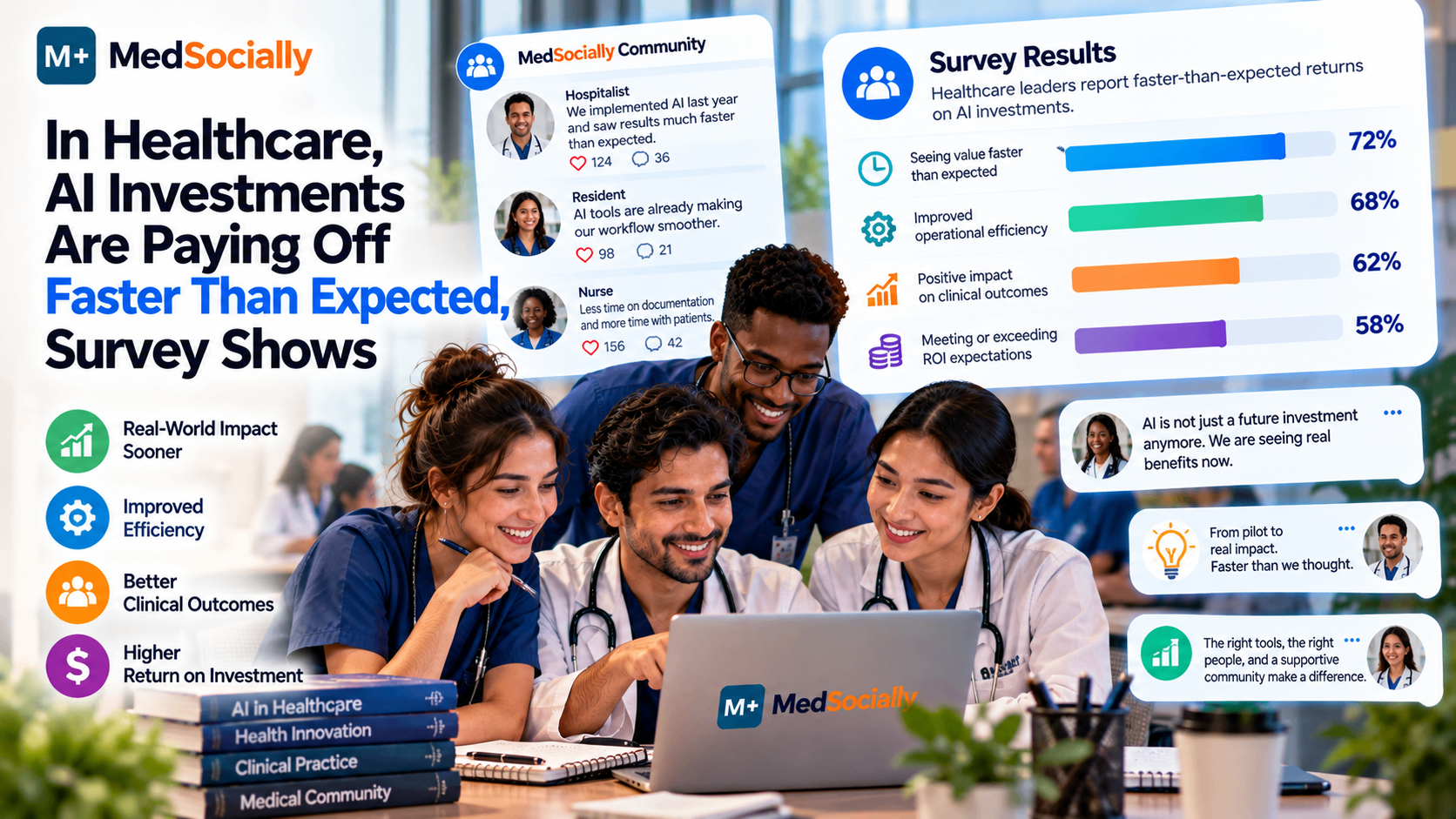
Platforms such as MedSocially can help create that kind of professional conversation by bringing physicians, nurses, researchers, healthcare leaders, and other professionals into shared healthcare communities.
The value is not simply networking.
A healthcare community can become a source of real world feedback about how Clinical AI is being used.
Clinicians can discuss whether a tool improves care, creates unnecessary work, produces questionable recommendations, or behaves differently across patient populations.
That kind of frontline feedback matters because AI governance cannot remain limited to data scientists, vendors, and hospital committees.
The people using Clinical AI at the bedside need a meaningful voice in how these systems evolve.
There is another unintended consequence worth considering.
Responsible Clinical AI is expensive.
Health systems need strong data infrastructure, cybersecurity, clinical informatics teams, governance programs, model monitoring, and technical support.
Large health systems may be able to build these capabilities.
Smaller hospitals may struggle.
That creates a potential digital divide.
Hospitals serving wealthier populations may gain access to more advanced AI tools and better monitoring systems, while under resourced facilities fall further behind.
If that happens, Clinical AI could unintentionally increase the very health disparities it was supposed to reduce.
Health equity therefore needs to include more than fairness inside the algorithm.
It must also consider whether healthcare organizations have equal ability to implement AI safely.
This is another area where broader healthcare communities can help.
Clinicians and healthcare leaders working in smaller or resource constrained organizations can benefit from shared experiences, practical lessons, and discussions about what actually works outside major academic centers.
Platforms such as MedSocially may help support these conversations by connecting healthcare professionals across different specialties, institutions, and practice settings.
The goal should not be to abandon health equity principles.
The goal should be to make them more practical.
Developers should begin by asking whether the problem being predicted is clinically meaningful.
Is the model predicting disease?
Or is it predicting how patients historically moved through the healthcare system?
Training datasets should be examined for missing populations, biased labels, and differences in access to care.
Clinical AI models should also be validated outside the institutions where they were developed.
Local testing matters.
A model that works in Boston may not perform the same way in rural Pennsylvania, Texas, or another country.
Health systems should also monitor AI after deployment.
Patient populations change.
Clinical workflows change.
Treatment guidelines change.
AI performance can change too.
A model should not receive permanent approval simply because it performed well during its initial validation.
Just as important, healthcare organizations should create ways for clinicians to report problems and share what they are seeing in practice.
Formal governance matters, but informal professional discussion matters too.
A healthcare community where clinicians openly discuss Clinical AI can reveal workflow problems, safety concerns, and equity issues long before they become obvious in a performance dashboard.
Clinical AI has enormous potential.
It can help physicians detect disease earlier, identify patients at risk, reduce administrative burden, and support clinical decisions.
But technology alone cannot fix unequal healthcare.
AI systems reflect the environments that create and use them.
If those environments contain limited access, inconsistent treatment, resource shortages, or poor follow up, AI may reproduce those problems in new forms.
That is why the health equity conversation needs to move beyond the algorithm.
It also needs to move beyond individual organizations.
Clinicians, researchers, technology developers, patients, and healthcare communities all have a role in questioning how these tools perform once they reach real clinical care.
Platforms such as MedSocially can contribute to that conversation by giving healthcare professionals a place to exchange experiences, challenge assumptions, and discuss how new technologies are affecting patient care.
Instead of asking only:
“Is this Clinical AI model fair?”
Healthcare leaders should ask:
“Who actually receives better care because this Clinical AI system exists?”
That question forces us to look beyond accuracy scores and fairness metrics.
It brings the conversation back to patients.
And ultimately, that is where health equity must be measured.
High cholesterol is one of those health problems that can quietly develop without causing any noticeable symptoms. You may feel perfectly healthy, go about your daily routine, a...
Applying for residency in the United States can feel overwhelming, especially when applicants are trying to understand programs from the outside. Program websites can explain cu...
Starting a medical career in the United States can be exciting, but it can also feel unfamiliar and isolating for many international doctors. Even physicians with years of clini...
Social media is no longer just a place where healthcare practices announce new office hours or post a photo on National Nurses Week. For many patients, it has become part ...