AI is in the midst of a swift transformation in healthcare.
New tools are added virtually every week.
Some are short summaries of medical research. Some make clinical notes. Identifying patient-specific details within medical records, making diagnostic recommendations, drafting discharge plans, interpreting medical imaging, and organizing medical information can be time-consuming for doctors, but AI can help with these tasks.
Doctors are listening.
Indeed, AI isn't just a spectator sport for most doctors.
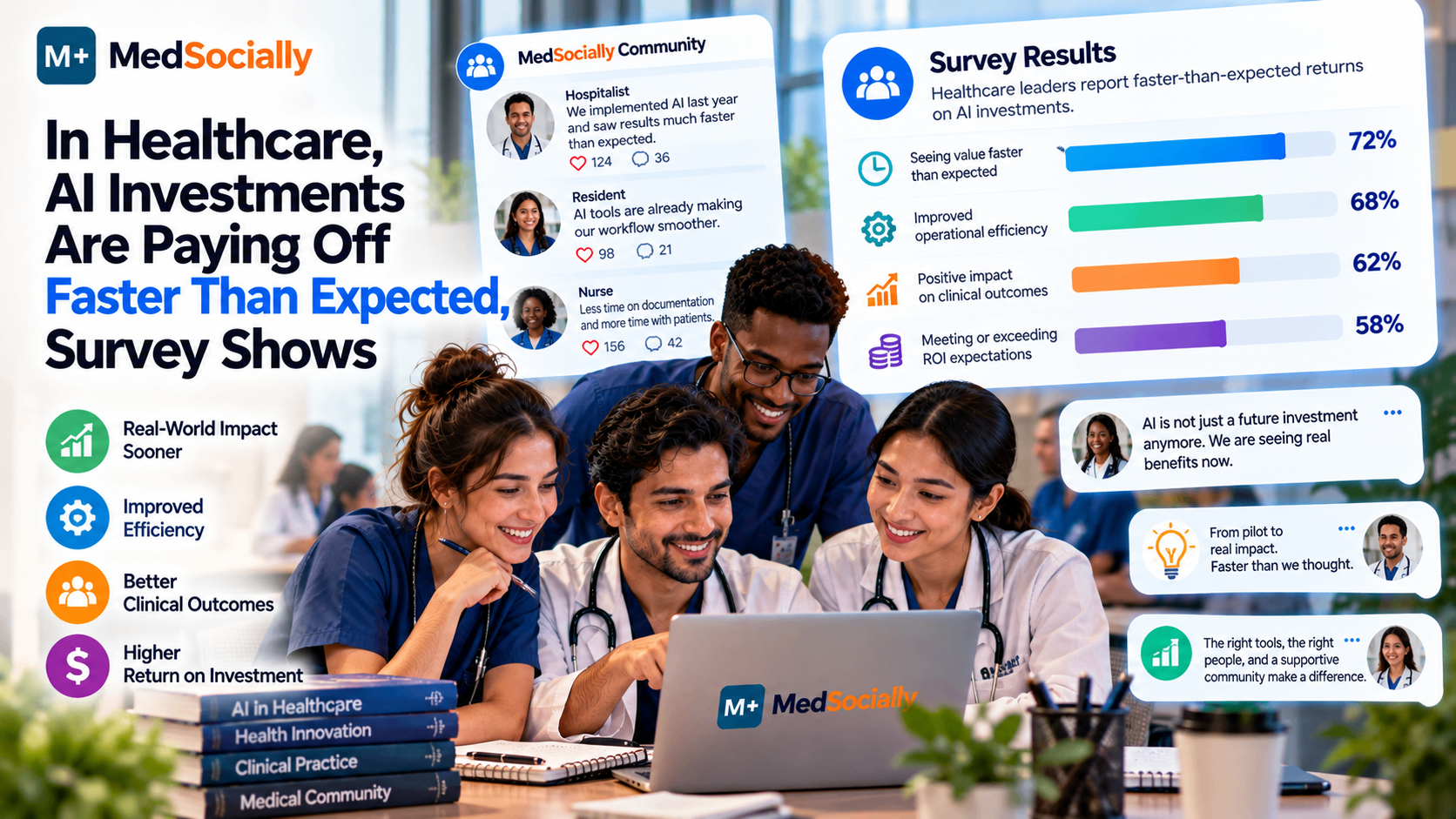
According to a survey by the American Medical Association, 81 percent of doctors were already utilizing AI professionally in 2026. The percentage is more than double the 38 percent that was reported by physicians when the AMA first asked about the use of AI in 2023. reference
The advancement of the technology has been rapid.
Healthcare has not.
And that divide is becoming one of the most critical areas of medical AI.
There is a tendency to frame the conversation around physicians being afraid of AI.
That does not really match what we are seeing.
Doctors are using it.
According to the AMA survey, 39 percent of physicians reported using AI to summarize medical research and standards of care. Thirty percent were using it to create things such as discharge instructions, care plans, or progress notes. Another 28 percent reported using AI for documentation and billing related work.
More than three quarters also said AI could improve their ability to care for patients.
That sounds less like resistance and more like cautious adoption.
Physicians can see where AI might help.
They know how much time is lost to documentation. They understand the challenge of keeping up with new medical evidence. They see the potential for technology to reduce repetitive work.
What they do not want is another system that creates more work than it removes.
Healthcare has been through that before.
A technology may show off great in a demonstration setting but not in a hospital setting.
That difference matters.
Clinical work takes place in places with lots of interruptions. Physicians scoot from patients to electronic records to nurses to consultants to medication orders, messages, documentation, discussions with other family members and to administrative tasks.
Any new AI system that comes in that goes into that environment is in that environment.
When the technology ends up as another task, because clinicians have to open another application, copy information between systems or repeatedly correct outputs, or confirm alerts that provide little value, the technology may simply become another task.
Documentation for Ambient AI has revealed both sides of the story.
There has been some research with encouraging results. In a 2025 multicenter study of clinicians who used an ambient AI scribe, the percentage of those who reported experiencing a burnout dropped from 51.9 percent to 38.8 percent after 30 days. Clinicians also commented on the reduction in documentation burden and their ability to concentrate on patients.
Other medical studies have pinpointed practical issues, however.
Physicians expressed worries about the accuracy of notes and the length of the notes. Others took time to edit what came out of the system. Lack of English proficiency among patients and the ease of access to the technology for clinicians were also limits.
That's where implementation is so important.
The question is not only:
Does the AI work?
It is:
Is there any relation between the AI and the actual practice of medicine?
Doctors make decisions in context.
The value of a laboratory test can be significantly different in different patients.
Treatment for the same diagnosis varies by age, medications, kidney function, social factors, goals of care, and a myriad of other factors.
AI can assist in arranging those details.
Can detect patterns.
It can even detect things that a clinician may not.
However, doctors are not keen on letting technology become a tool to make the decision.
This concern is particularly acute in the case of patients being the ones using AI directly.
Overall, the AMA determined that doctors felt more at ease with patients using AI to access basic health information than for decisions that would require clinical judgment. Almost 50 percent strongly disagreed with patients using AI for self-diagnosis of patient data like radiology or pathology results.
That's not the end of patients having access to information.
It's a lesson that medicine has always learned.
Information is not interpretation.
An AI company could boast that their model is very accurate.
There is a need for more information by the doctor.
What were the subjects of the test system?
What happens if it's incorrect?
Is it applicable to other populations?
Has it been tested on a patient who is experiencing the same symptoms as me?
Does performance vary from one time to another?
What information would be transmitted outside of the health system?
What if the AI recommendation leads to a negative outcome?
These are "how to" questions.
They also make up some of the largest hurdles for physician trust.
"Eighty-eight percent of 2026 AMA providers in the survey indicated that robust safety and effectiveness validation is a key factor in wider AI adoption. 86 percent cared about data privacy. Furthermore, there was a priority in the regulatory landscape for clear liability rules." reference
Doctors are not calling on AI to be infallible.
Medicine is not a perfect; the medicine itself is not perfect.
They want to have the right level of transparency to be able to decide when it's a good tool and when it's not.
There's another issue.
AI is being introduced to healthcare professionals in very different ways.
Some doctors are aware of LLM functioning and regularly play with them.
Others will have access to a new hospital AI tool, following a brief training session.
Medical students and residents are entering a healthcare environment where AI can likely already be involved in research to answer clinical questions, note taking, and summarizing patient information.
That makes for a new educational obligation.
The clinicians must be able to detect weak outputs.
They have to know what hallucinations are and automation bias, but not become AI engineers.
They must be aware of which patient data can be securely added to various tools.
They should also be aware of when they are using AI to aid their reasoning and when it may be taking over their reasoning without them knowing.
Doctors are already concerned about such a scenario.
The AMA discovered that 88% felt concerned about any element of clinical skills being lost due to AI. 70% indicated a concern particularly regarding loss of skills in medical students and residents.
Training can not only be limited to software operation.
It needs to help educate doctors on how to question it.
There is one statistic that may be more important than all the other statistics in the AMA survey. 85% of doctors desired to be consulted on or directly engaged in decisions regarding AI use. But that shouldn't come as a surprise.
However, the path to the introduction of healthcare technology has been very different. Leadership selects an platform. IT integrates it. Clinicians receive training. Then all the problems with the workflow are noticed after the implementation. AI provides healthcare the chance to do it differently.
Physicians should be involved prior to the acquisition of a system. Nurses should be involved. Pharmacists must have a role to play when medication decisions are impacted. Patients also might require a voice.
The folks familiar with the work can frequently discover issues that are not apparent during product demonstration. That does not hinder innovation. It is enhancing implementation.
Hospitals are not the only institutions trying to keep pace. Regulators face the same challenge. Traditional medical products usually change slowly. AI systems can be updated continuously. Their performance can also change when patient populations, workflows, or data change. That makes traditional regulation difficult.
The FDA has increasingly emphasized monitoring AI enabled medical devices across their entire life cycle rather than treating authorization as the end of oversight. Its guidance has highlighted transparency, bias, ongoing performance monitoring, and communication about limitations.
The federal HTI 1 rule has also introduced transparency requirements for predictive algorithms within certified health information technology. That matters because certified health IT supports care in more than 96 percent of hospitals in the United States. These are important steps. But regulation will continue to evolve because the technology itself keeps changing.
AI adoption cannot be controlled entirely by technology companies.
It cannot be controlled entirely by hospital executives either.
Good healthcare AI requires conversation between people who understand different parts of the problem.
Developers understand the technology.
Physicians understand clinical decision making.
Nurses understand bedside workflows.
Health system leaders understand operational constraints.
Regulators think about safety at scale.
Patients understand something equally important.
What it feels like to receive care.
Healthcare communities can help connect those perspectives.
Platforms such as MedSocially can give physicians, nurses, researchers, and other healthcare professionals a place to compare experiences with new technology and discuss what actually happens after AI leaves the demonstration room and reaches clinical care.
One hospital may discover a workflow problem.
Another may already have solved it.
A physician may notice a strange AI recommendation.
Someone in another health system may be seeing the same pattern.
Those conversations will become increasingly valuable as AI adoption grows.
Healthcare does not need to match the speed of Silicon Valley.
It probably should not.
A social media application can release a flawed feature and fix it next week.
A clinical system does not have that luxury when patient care is involved.
But moving carefully should not mean standing still.
Physicians are already using AI.
They can see its potential.
What they want now is something more mature.
AI that fits the workflow.
AI that has been properly tested.
AI that protects patient information.
AI that explains its limitations.
AI that supports clinical judgment instead of quietly replacing it.
And perhaps most importantly, physicians want to be part of deciding how these systems enter healthcare.
The technology will keep moving.
The question is whether healthcare can build the training, governance, regulation, and collaboration needed to move with it.
Because the future of medical AI should not simply be something that happens to physicians.
Physicians should help shape it.
The patient is explaining her symptoms. The physician is listening, making eye contact and asking follow up questions. There is no constant typing and no computer screen competi...
High cholesterol is one of those health problems that can quietly develop without causing any noticeable symptoms. You may feel perfectly healthy, go about your daily routine, a...
Applying for residency in the United States can feel overwhelming, especially when applicants are trying to understand programs from the outside. Program websites can explain cu...
Starting a medical career in the United States can be exciting, but it can also feel unfamiliar and isolating for many international doctors. Even physicians with years of clini...